Story Quilts: How Our Ancestors Wove Survival, Memory, and Resistance Into Every Stitch

I’ve been thinking about the things our people learned to save, like money and food and letters...
They also saved fabric scraps too.
A worn dress.
A child’s shirt.
A flour sack.
A piece of somebody’s Sunday best folded and kept long after their body returned to the ancestors.
That stays with me because for so many Black communities across the African Diaspora, cloth was never just cloth. It held warmth. It held grief. It held beauty. It held identity. It held memory when memory was not safe on paper. It held what life was like. It held who we were.
And sometimes, it held who we refused to stop being.
A quilt can be bedding. A quilt can be a family archive. A quilt can be a prayer laid flat across the body. A quilt can say, with no need to shout: We are still here.
what our ancestors made from what was left
When I look at Black quilting traditions across the Americas, I do not see “craft” in some small, dismissive sense. I see intelligence. I see improvisation. I see spiritual endurance. I see women making a way with what was in reach and still refusing to make something empty.
Black quilting traditions developed through many streams meeting at once: African textile influences, European patchwork techniques, local materials, oral storytelling, and the brutal realities of enslavement, displacement, and survival. Enslaved Africans carried deep knowledge of textile design into the Americas. Knowledge of pattern. Knowledge of color. Knowledge of appliqué. Knowledge of symbolic expression. Knowledge of rhythm in visual form.
That matters.
Too often history is told as if our ancestors arrived with only loss and despair. But they also arrived with memory and skill and design sense. They arrived with cosmology and ways of seeing order, movement, and meaning in cloth.
Then came the violence of forced labor. The deprivation and despicable living conditions. The constant narrowing of what was allowed, what was owned, what was possible. And still, Black women transformed worn clothing, discarded fabrics, seed sacks, and household scraps into bedding and useful household objects.
Yes, necessity was there - but necessity was never the whole story.
They did more than cover beds. They made beauty from remnants. They made continuity from interruption. They made pattern from pressure. Through asymmetry, improvisation, bold color, repeated forms, and unexpected combinations, they turned what others overlooked into something living.
This is ancestral instruction:
What has been discarded can still carry purpose.
I come back to that often. Maybe you do too.
Not because we romanticize struggle. Not because harm was holy. But because our people knew how to transform what came into their hands. And maybe that is part of your work now too...
A quilt can remember what paper could not
There are histories that were never given the protection of written record. There are names that did not make it into ledgers with care. There are family stories that were not granted permanence by the state. There are lives that had to be carried another way.
So oral tradition became essential.
So did the body.
So did song.
So did foodways.
So did hair.
So did ritual.
So did craft.
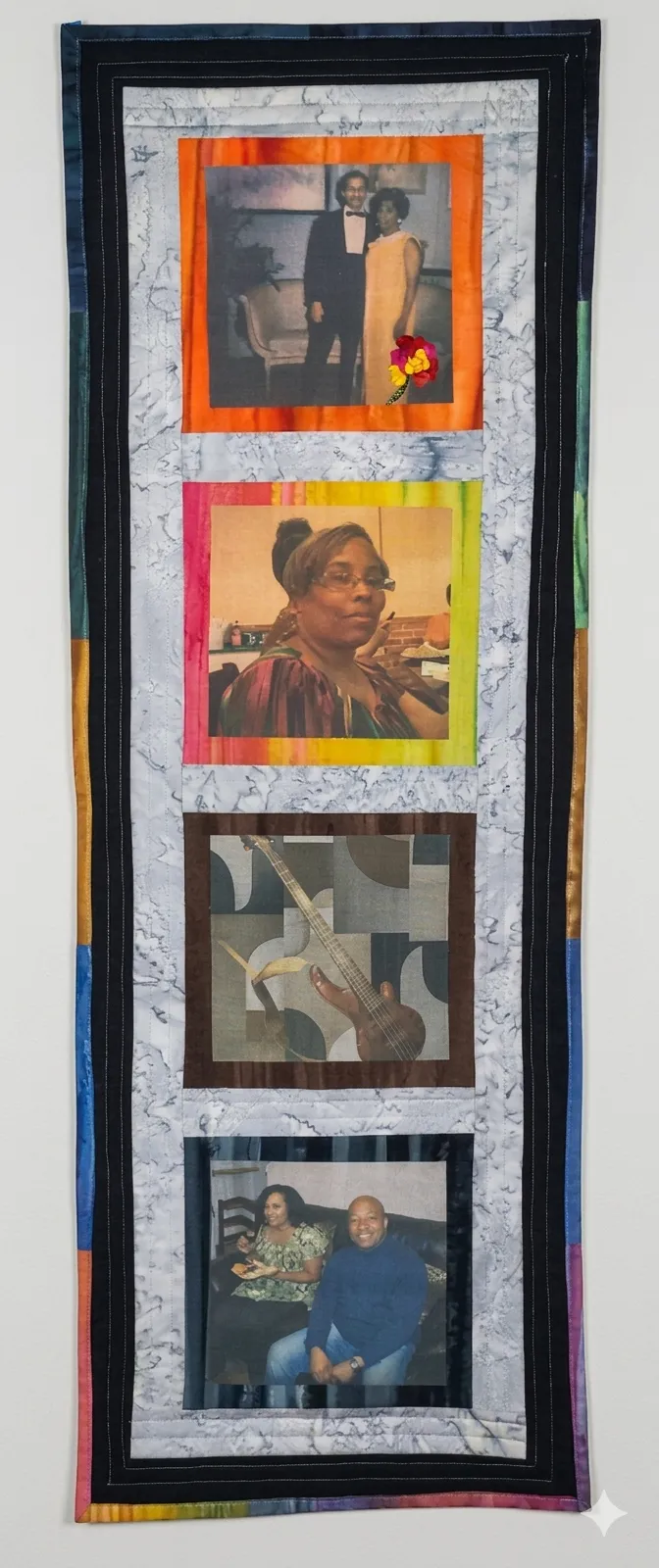
Somewhere along the line, quilts entered that living archive. Some preserved memory through fabric taken from a loved one’s clothing. Others marked births, marriages, deaths, migrations, church gatherings, military service, and community milestones. A quilt could quietly say what the world might never record with dignity:
This person lived.
This family endured.
This moment mattered.
These hands belonged to someone.
We remember.
The National Gallery of Art describes quilts as embodying the legacy of Black America, and the Smithsonian explores how Black women have long used quilts to tell their stories. And when you look closely, you can feel why.
Look closely at a memory quilt and you may find more than design. You may find somebody’s Sunday dress. A child’s shirt. A military uniform. A scrap saved from a house that no longer stands.
The fabric becomes witness. The fabric becomes testimony. The fabric becomes an ancestor’s voice.
Harriet Powers stitched story into history
When I think about story quilts in African American history, I think of Harriet Powers.
Harriet Powers was born into slavery in Georgia in 1837. That sentence alone carries a world. And still, what she made continues to speak with force.
She created narrative quilts that brought together biblical scenes, local history, spiritual teachings, and observations of the natural world. Her surviving works, the Bible Quilt and the Pictorial Quilt, use appliquéd figures and symbols to create scenes that feel almost like a visual text - like a book, yes.
But a book made of cloth.
That difference matters to me because it reminds me that storytelling does not begin and end with a pen in the hand of someone society decided to legitimize. Storytelling can begin with memory and image. It ca begin with spiritual imagination and the courage to make what you know visible.
Harriet Powers did that. Her work is documented through collections including the Smithsonian’s National Museum of American History and the Museum of Fine Arts, Boston. She did not simply decorate fabric. She interpreted the world. She gathered story, symbol, and spirit into form. She refused disappearance.
That is not small nor not decorative. That is ancestral wisdom in motion.
Faith Ringgold and the story quilt as living testimony
And Harriet Powers is not the only one who shows us what a story quilt can hold.
Faith Ringgold expanded that lineage in a different era and with a different visual language, but with a related insistence: that Black life, Black memory, Black girlhood, Black womanhood, Black imagination, and Black political truth belong fully in the frame.
Ms. Ringgold is widely known for her narrative story quilts - works that join painting, quilting, and text. In her hands, the quilt became not only a domestic object or inherited practice, but also a bold storytelling surface for contemporary Black experience. Her pieces speak about family, race, gender, freedom, beauty, movement, and the inner life of Black women and girls.
I love that because it stretches the conversation.
It reminds us that story quilts are not only about preservation of the distant past. They are also about claiming authorship in the present. They are about saying: our stories are art. our stories are history. our stories are worthy of being seen in full color.
Faith Ringgold’s work helps us see the story quilt as an ongoing form. Not frozen. Not finished. Still speaking/expanding/making room.
The quilt circle was also a circle of care
Quilting has so often been communal that I don’t think we can talk about quilting without talking about gathering.
Women came together around shared work, yes. But the work was never only the stitching. It was also the atmosphere. The exchange. The safety. The everyday intimacy of being with one another while hands stayed busy. There were conversations and laughter.
There were recipes passed over tables. There were children nearby. There were worries named out loud. There were practical solutions. There was mourning. There was teasing. There was counsel. There was room for life to be life.
A quilting circle could become a place where knowledge moved naturally from one generation to the next. A younger person learned how to hold a needle, but also how to listen. An elder passed along technique, but also discernment, timing, memory, and also how to stay with something until it held.
That kind of circle feels holy to me.
Not because it was perfect - but because it was communal. Because it made room. Because nobody had to arrive polished to belong.
That still matters.
We still need spaces where we do not have to explain every layer of ourselves before we are welcomed. We can simply arrive. We can bring the unfinished piece. We can let someone else hold the thread for a moment.
[If you would like to sit in circle and make your very own story quilt, please visit the Stitch Your Story: Sankofa's Silhouette website for full details.]

What story quilts teach us now
Even if you never touch a quilting frame, this wisdom can still meet you. Even if you don’t sew or if nobody in your family calls themselves an artist. Even if your own memories feel scattered.
A story quilt teaches us to gather the pieces.
That part feels so tender to me. Not every piece looks beautiful by itself. Some pieces carry grief. Some carry silence. Some come from seasons you thought you had already outgrown. Some feel too ordinary to matter.
Gather them anyway.
A story quilt teaches us that healing is rarely one uninterrupted piece. It is layered. Repeated. Hand-finished. Held together through small acts of attention. A story quilt teaches us to honor the fragments without letting the fragments become the whole story.
And it teaches us that remembrance can be creative - not performative, not forced - but creative.
You can make a memory square from fabric, paper, photographs, words, or colors. You can choose one small piece that represents someone who came before you and place it somewhere meaningful. You can write down a story you do not want your family to lose.
Begin simply:
Choose a piece of cloth, clothing, paper, or image connected to a memory.
Place it on a clean surface.
Speak the person’s name, if you know it.
Write one sentence about what they carried or gave.
Add a sentence about what you choose to carry forward — and what you are ready to set down.
This is not about recreating a sacred tradition that does not belong to you. It is about practicing remembrance with humility. Notice that your life is part of a larger fabric and let memory become a ritual of return.
You are part of the living quilt
I believe this deeply:
Your ancestors did not hand you a finished story - they handed you material.
Some of it is vibrant, some frayed. Some of it has been hidden away for years.
Some of it still needs to be unfolded in gentle light. It is in your hands now...
You are allowed to choose what becomes part of the next panel and to mend without pretending nothing happened. You are allowed to create beauty without denying the pain that came before you and rest beneath the work of those who made survival possible.
You are allowed to continue the pattern in your own way.
This is part of how I hold the work. I believe ancestral wisdom, sound, energy, and spiritual practice can meet you right here in the present moment — not to make you into someone else, but to help you return to what is already true inside you. If you feel called to explore that connection, you’re welcome to learn more about the services offered through The Ancestral Alchemist or book a complimentary Discovery Call.
Come as you are and bring the unfinished piece. There is no need to arrive complete. The ancestors already know you are becoming...
A blessing for the thread you carry
May you remember the hands that made a way.
May you honor the stories that survived.
May you trust that what was left to you still carries life.
May you release the weight that was never yours to keep.
May you add your own color, your own pattern, your own living truth.
May the thread stay unbroken where it needs to stay unbroken.
May what is ready to be mended find gentle hands.
The thread continues.
And so do you.